The Maximo Upgrade Process
A leadership-ready framework to reduce upgrade risk, protect business continuity, and ensure Maximo delivers measurable outcomes after go-live.
Executive Summary
Upgrading Maximo isn’t just another IT project, it affects how people plan their work, handle maintenance, and make everyday decisions. When the upgrade is done well, everything runs smoothly: operations stay on track, compliance risks stay low, and costs don’t spiral out of control. Just as importantly, the system becomes easier for teams to use. This field kit gives you a straightforward, practical approach to get everyone on the same page, avoid scope creep, spot risks early, and make sure the upgrade delivers real, lasting results.
The Upgrade Process
Use this visual as the shared roadmap across operations, reliability, IT, and vendors. It keeps focus on what matters most: business alignment, disciplined execution, and durable adoption.
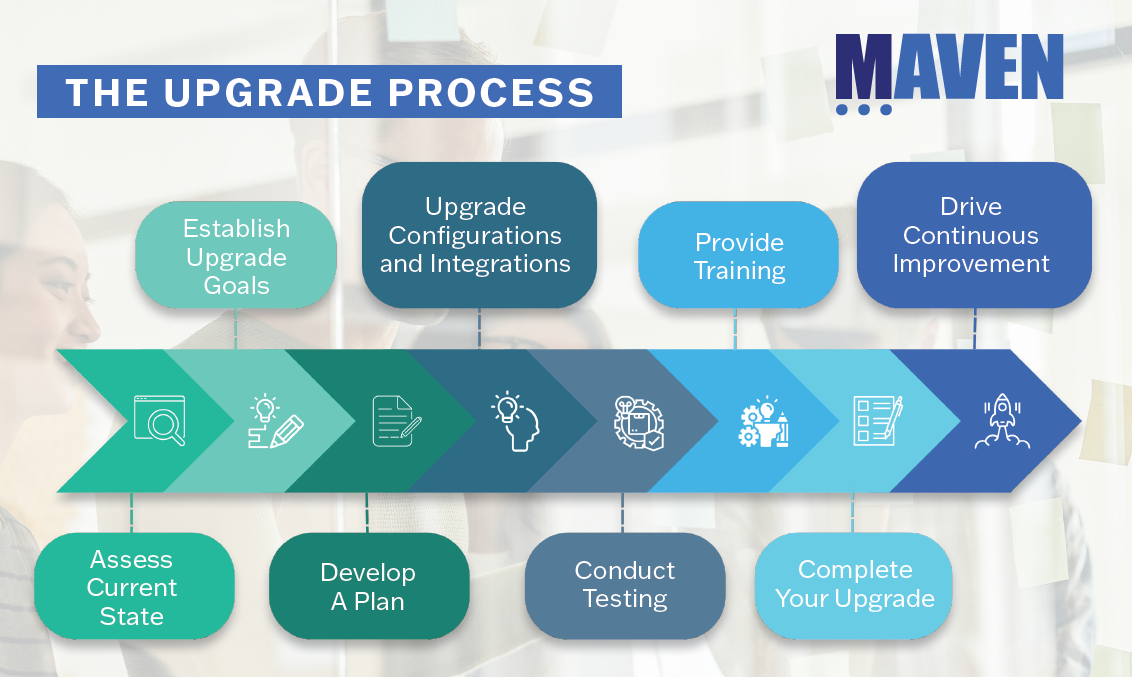
1) Assess Current State
Establish a fact base before decisions are made. Capture technical realities and operational realities, not opinions.
- Platform baseline: version, modules, environments, integrations, interfaces, security model
- Operational baseline: planned vs. unplanned work, backlog health, critical workflows, reporting dependencies
- Configuration footprint: customizations, automations, escalations, scripts, add-ons
- Risk inventory: downtime sensitivity, regulatory impact, seasonal constraints
Executive output: a clear readiness picture and risk profile to guide scope and sequencing.
2) Establish Upgrade Goals
Define what “success” means in business terms. Upgrades that are justified only by “getting current” tend to underperform.
- Business outcomes: reduce downtime, improve planning discipline, strengthen compliance, enable mobile, improve analytics
- Scope intent: technical upgrade only vs. upgrade + workflow improvements
- Success measures: adoption metrics, data quality measures, performance KPIs, reliability outcomes
- Decision ownership: establish who signs off on scope, risk, and go-live readiness
Executive output: a goals statement and success criteria that align all stakeholders.
3) Develop a Plan
Convert objectives into a controllable plan: sequenced, resourced, and governed. Plan for testing and change management early.
- Delivery approach: big-bang vs. phased; environment strategy; cutover strategy
- Workstreams: technical, integration, data, security, reporting, training/change
- Governance: steering cadence, decision log, scope control, risk management
- Quality gates: clear entry/exit criteria for build, test, UAT, go-live
Executive output: a plan that is measurable, auditable, and built for predictable execution.
4) Upgrade Configurations and Integrations
Protect business continuity by deliberately managing what changes and what must not break. Integration failures are a common upgrade risk multiplier.
- Configuration migration: validate what will move cleanly, what must be rebuilt, what should be retired
- Integration readiness: interface compatibility, error handling, scheduling, performance
- Security & roles: confirm access models, segregation of duties, and audit expectations
- Reporting dependencies: downstream consumers, BI tools, extracts, regulatory reports
Executive output: a controlled build with reduced risk of downstream disruption.
5) Conduct Testing
Testing is where leadership buys down risk. Focus on real workflows and failure scenarios, not just happy-path clicks.
- Process-based testing: end-to-end scenarios for critical work (planning → execution → closeout)
- Integration testing: validate triggers, timing, failures, and data integrity across systems
- Performance validation: response time, batch jobs, high-volume transactions
- Cutover rehearsal: timing, rollback plan, stakeholder communications
Executive output: confidence that go-live will protect operations and compliance.
6) Provide Training
Adoption is the difference between a “successful upgrade” and meaningful business value. Training should be role-based and operational.
- Role-based enablement: planners, supervisors, technicians, storeroom, reliability, leadership
- Workflow reinforcement: what changed, why it matters, how success will be measured
- Job aids: short guides for critical transactions and new features
- Support model: hypercare plan, escalation paths, feedback loop
Executive output: higher adoption, fewer workarounds, and faster stabilization.
7) Complete Your Upgrade
Go-live should be treated as a controlled operational transition, with decision clarity and measurable readiness gates.
- Readiness review: sign-offs against criteria for testing, training, data, integration, and cutover
- Hypercare: rapid triage, daily check-ins, defect prioritization, communication cadence
- Stabilization metrics: incident rates, cycle times, backlog trends, user adoption indicators
Executive output: controlled cutover with operational stability and transparent risk management.
8) Drive Continuous Improvement
The real value is captured after go-live. Use the upgrade as the starting point for stronger reliability execution and governance.
- Backlog of value: improvements and optimizations identified during upgrade work
- Governance: data ownership, standards, KPI cadence, and accountability
- Reliability maturity: improve failure coding, PM effectiveness, planning discipline, analytics adoption
- Release strategy: establish a sustainable approach to ongoing Maximo changes
Executive output: Maximo evolves into a performance platform, not a maintained system.
Leadership Takeaways
- Anchor upgrades to business outcomes to avoid “technical success / operational disappointment.”
- Make testing and training leadership priorities because they are the primary levers for risk and adoption.
- Use go-live as a transition, not a finish line—continuous improvement is where value compounds.