For many years, IBM Maximo has been viewed primarily as an Enterprise Asset Management (EAM) platform. It was the system operations teams lived in and maintenance departments owned. IT organizations often operated in entirely separate service management environments.
That perception did not appear by accident.
IBM’s IT service management capabilities — commonly known as IBM Control Desk — have moved through several phases within the Maximo ecosystem. Teams that experienced those transitions tend to approach Maximo for IT differently than organizations encountering the platform for the first time.
Understanding this history is not just interesting background. It often determines whether modernization efforts become smooth migrations or disruptive transformations.
Control Desk and Maximo Have Evolved Together
Many organizations do not realize that IT service management capabilities originally existed inside Maximo itself.
Early implementations used the same Maximo platform for:
- work management
- workflow automation
- asset records
- reporting and operational data
At that stage, Maximo was not simply viewed as an EAM platform. It functioned as a broader service and asset management system supporting both operations and IT workflows.
Over time, IBM separated these capabilities into a dedicated product called IBM Control Desk.
This change introduced new distinctions:
- Maximo became closely associated with EAM
- Control Desk became the platform for IT service management (ITSM)
Organizations built years of process design, customization, and governance around this separation.
Today, those capabilities have rejoined the ecosystem through the Maximo Application Suite (MAS).
Why This History Still Matters
Organizations modernizing today rarely start from a clean slate. Most environments contain years of accumulated design decisions and assumptions.
These may include:
- workflows originally designed for Control Desk
- Maximo implementations that never anticipated IT service management
- legacy customizations that no longer align with MAS architecture
- uncertainty around AppPoints licensing
Without understanding the platform’s evolution, organizations often misinterpret what Maximo for IT represents today.
Some assume it is simply:
- “EAM with service tickets”
Others assume it is merely:
- “Control Desk moved into the cloud”
In reality, modern MAS environments represent something different: a unified platform supporting both operational asset management and IT service management.
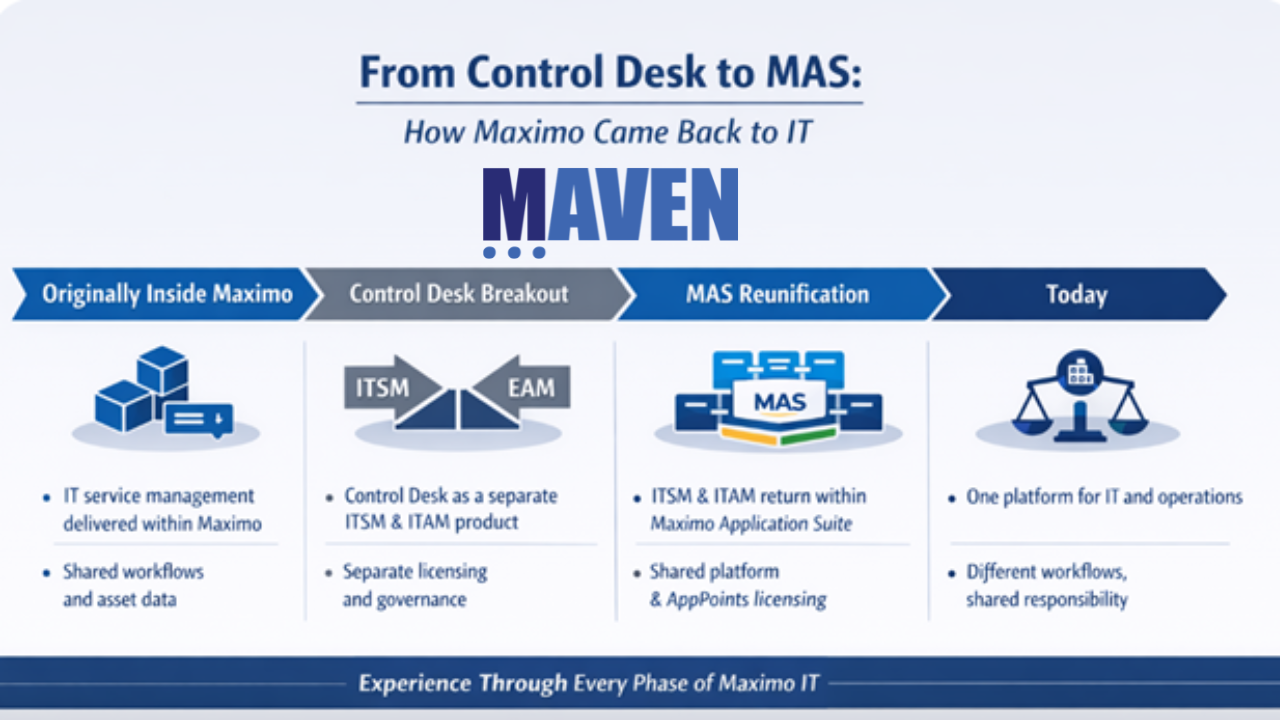
Control Desk, Maximo, and MAS Timeline
The relationship between Maximo and IT service management has passed through three distinct phases.
1. Originally inside Maximo
Early Maximo deployments included IT service management capabilities directly within the platform. Work management, assets, and service workflows shared a common data model.
2. Control Desk breakout
IBM later introduced Control Desk as a separate ITSM and ITAM product with distinct licensing, governance, and implementation models.
3. MAS reunification
With the introduction of the Maximo Application Suite, IT service management and IT asset management capabilities returned to the Maximo platform with a shared architecture and consumption model.
This reunification allows organizations to manage operational assets and IT services within a common environment.
How AppPoints Changed Design Decisions
The Maximo Application Suite introduced AppPoints, a shared licensing model that allows multiple MAS applications to consume from the same capacity pool.
This shift means that system design decisions now influence platform consumption and cost more directly.
Key areas affected include:
- workflow design and automation
- integration patterns
- service transaction volumes
- governance and usage monitoring
Organizations that underestimate the operational implications of AppPoints may experience unexpected licensing behavior after deployment.
Why IT Workflows Require a Different Approach
Even within MAS, IT workflows differ significantly from traditional maintenance workflows.
IT service management environments typically emphasize:
- SLA-driven service delivery
- rapid response cycles
- audit and compliance tracking
- extensive integrations
Treating IT service management as a simple variation of maintenance management can introduce operational friction.
Successful Maximo for IT environments are intentionally designed to accommodate the unique requirements of service management.
Experience Across Every Phase
Organizations implementing Maximo for IT often encounter legacy patterns that originate from earlier phases of the platform’s evolution.
These may include:
- Control Desk workflow models
- earlier Maximo customizations
- governance structures built around separate platforms
Successful modernization involves understanding which elements remain valuable and which assumptions should be reconsidered.
Maven has worked with organizations across every stage of this evolution, from early Maximo-based IT service management environments through Control Desk deployments and modern MAS implementations.
The Goal for IT Leaders
For IT managers planning modernization, the objective is not simply upgrading technology.
Successful initiatives focus on:
- preserving effective service management discipline
- avoiding outdated platform design patterns
- understanding MAS licensing and governance models
- building a stable service management platform
Organizations that recognize the historical context behind Maximo’s IT capabilities are better prepared to design environments that support both operational and IT requirements.
Related Resources
Readers exploring this topic may also find value in related areas such as:
- Control Desk migration strategies
- MAS licensing and AppPoints governance
- enterprise service management design
- IT asset management within MAS
Additional guidance and technical insights are available throughout the Maven Insights library.